NewOmnichannel Payment Gateway & Merchant Management — one gateway for every paymentExplore
Venture Capital
About Us
Contact us Our offices
Omnichannel payment gateway

Payment orchestration platform for Gulf banks: one gateway for every payment.

FirstFintech's payment orchestration platform gives banks, fintechs and enterprises in the UAE and across the Gulf one gateway for online checkout, wallets and QR, and in-store POS. Every payment is validated against your core systems, sent to the provider configured for that merchant, and logged end to end under a single reference.

  • ISO 27001
  • PCI DSS
  • SOC 2
  • 180+ clients since 2010
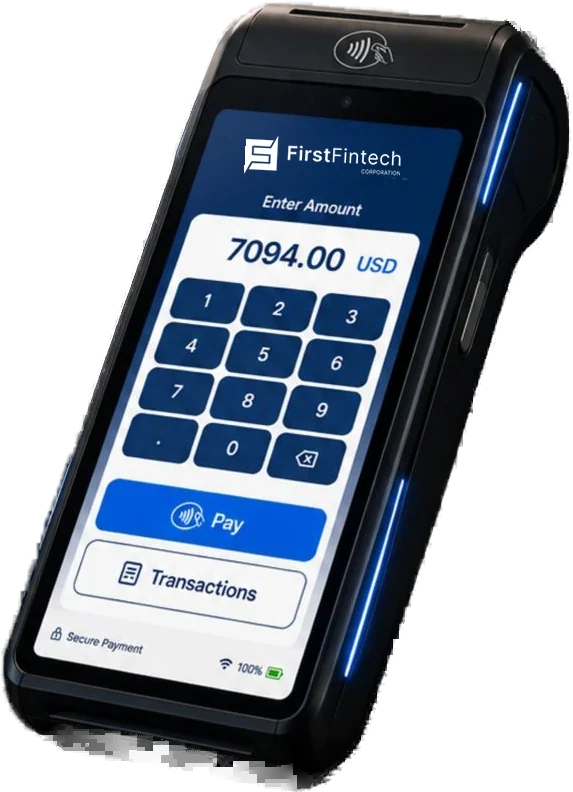
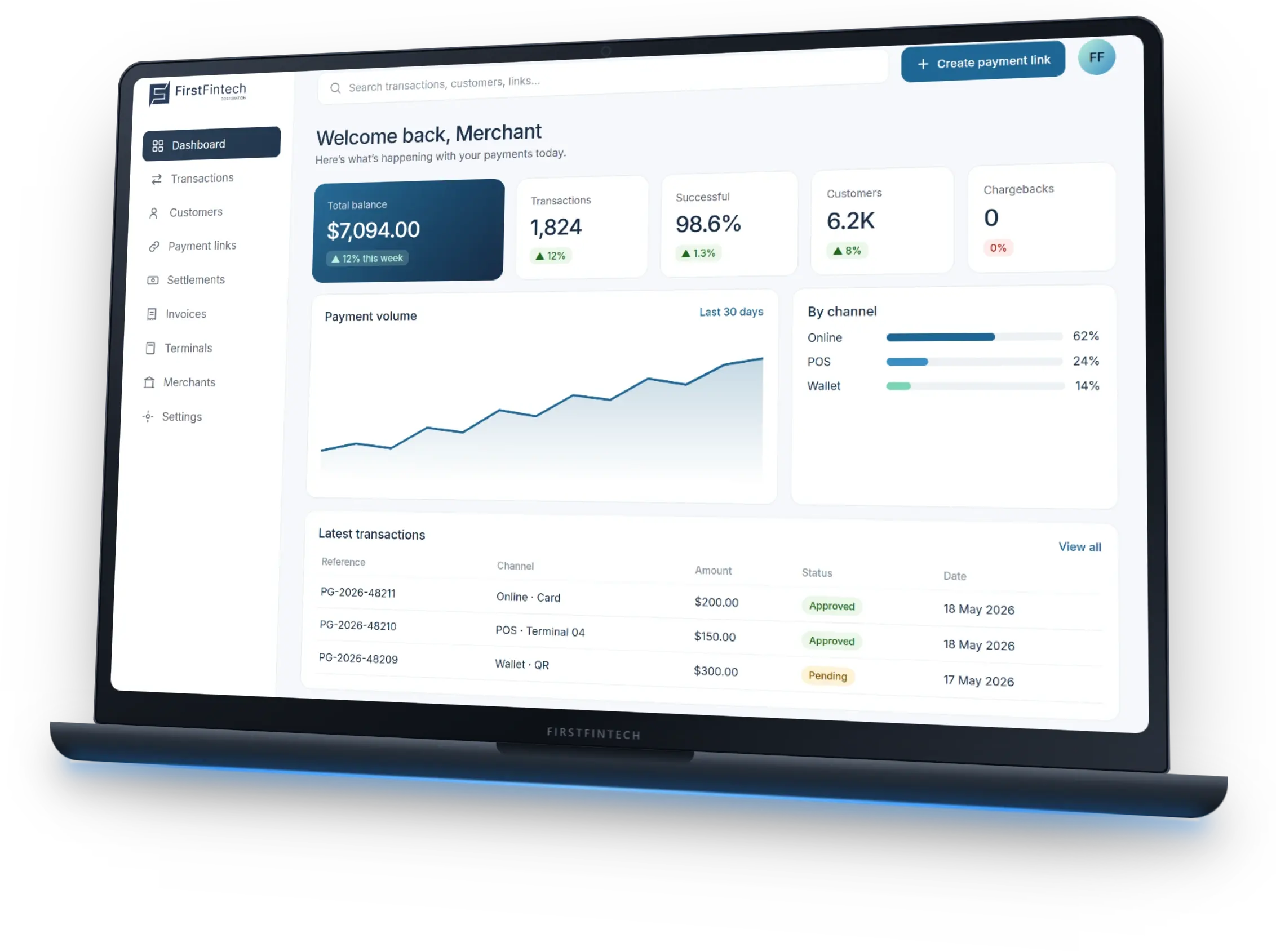
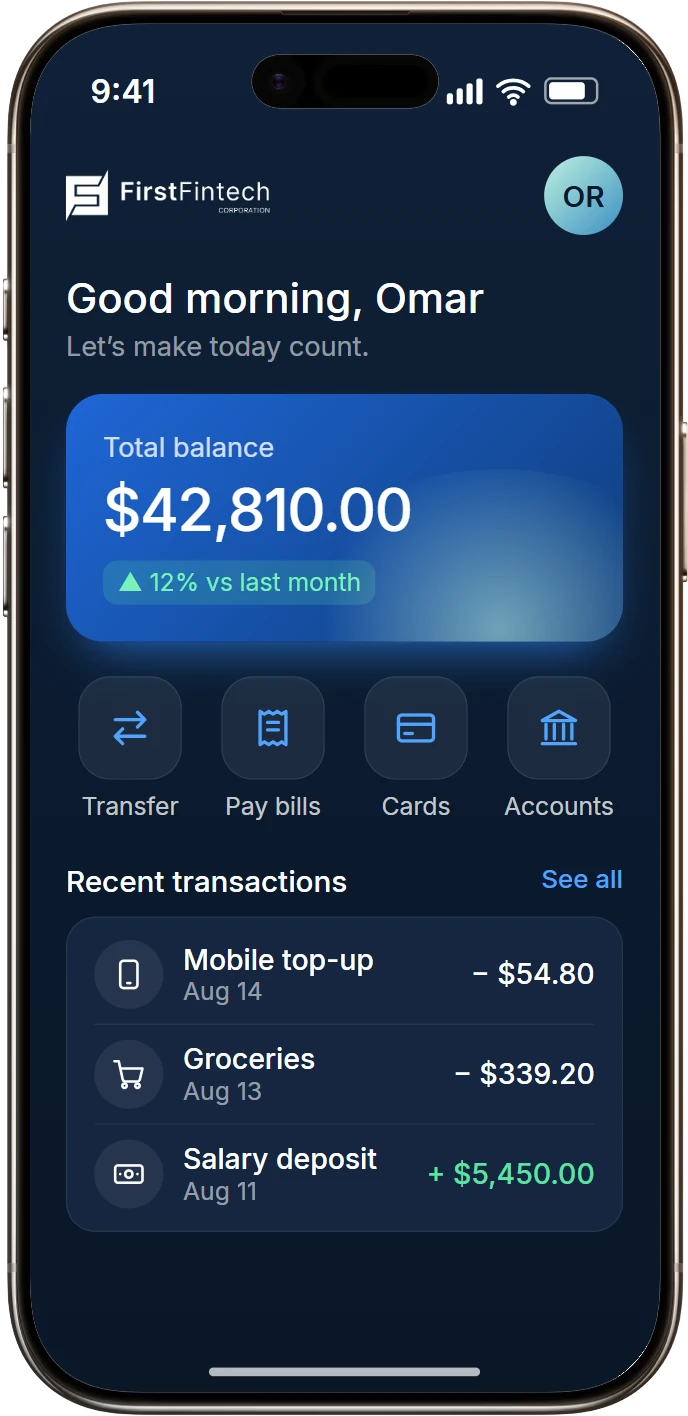
Payment approved · invoice returnedAmount pushed to terminalReceipt archived · SMS sent
Card terminal Merchant dashboard Mobile banking app
One gateway · every channel
Payment orchestration

What is a payment orchestration platform?

A payment orchestration platform is one layer that manages multiple payment gateways, providers and methods through a single API. Instead of building a separate integration for every acquirer, wallet or terminal, you connect once and choose providers by configuration.

Channels

Online checkoutWeb and mobile apps
Wallets & QRPay-by-phone methods
POS & SoftPOSIn-store terminals

Entry

API GatewayTLS · authentication · routing

Core services

Payment ServiceValidation · routing · payment log
POS ServicePush amount · payment advice
Receipts & notificationsArchive · SMS · e-mail
Merchant ManagementMerchants · terminals · settlement

Connected systems

Card gateways & acquirersCyberSource and more
Wallet providersLocal schemes
Core banking / ERPValidation · invoices
Document archive, SMS, e-mail
Shared data layerPayment database & logMessage broker for eventsKubernetes platform

In FirstFintech's platform, that layer is a single API Gateway in front of dedicated services for each channel, with one adapter per provider, so a new payment method plugs in without touching the rest of the system. Which provider handles a merchant's payments is set in the Merchant Management System, not in code.

Gateway vs orchestration

How is a payment gateway different from payment orchestration?

A payment gateway authorizes and authenticates individual transactions along one pathway; orchestration sits above several gateways and providers and decides where each payment goes. FirstFintech gives you both in one platform, so you don't need one vendor for the gateway and another for routing.

Gateway, orchestration layer, FirstFintech
Payment gatewayOrchestration layerFirstFintech
What it doesAuthorizes individual transactionsManages several gateways and providersGateway and orchestration in one platform
ChannelsUsually one, such as online checkoutWhatever its connected gateways supportOnline, bank-hosted pages, wallets & QR, POS and SoftPOS
Adding a payment methodA new integrationA new connection in the layerA new provider adapter, nothing else changes
Merchants, terminals, settlementManaged elsewhereManaged elsewhereBuilt-in Merchant Management System

Want the longer version? Read our guide to payment orchestration vs payment gateway.

Payment methods

Can one integration handle online, wallet/QR and in-store payments?

Yes. One integration covers card gateways such as CyberSource, bank-hosted payment pages, wallets and QR payments, and POS and SoftPOS terminals.

Card gateways · CyberSource
Bank-hosted payment pages
Wallets & QR payments
POS & SoftPOS terminals

With SoftPOS, merchants can turn an NFC smartphone into a payment terminal, without extra hardware.

E-commerce flow

How does payment gateway integration work with your core banking or ERP?

Every online payment is checked against your core banking system or ERP before it goes to the bank, and an approved payment comes back to your channel with its invoice in the same response. A declined payment returns to your channel immediately, without contacting your core system again.

Your channelWeb · app
FirstFintech GatewayPayment Service
Core banking / ERPValidation · invoices
Bank / providerCyberSource · acquirer
1Payment request
1Payment requestYour channel → Gateway
2Validate payment details
2Validate payment detailsGateway → Core banking / ERP
3Details valid
3Details validCore banking / ERP → Gateway
4Submit for processing
4Submit for processingGateway → Bank / provider
5aApproved
5aApprovedBank / provider → Gateway
6aRequest invoice details
6aRequest invoice detailsGateway → Core banking / ERP
7aInvoice & receipt details
7aInvoice & receipt detailsCore banking / ERP → Gateway
8aResponse with invoice
8aResponse with invoiceGateway → Your channel
5bDeclined
5bDeclinedBank / provider → Gateway
6bDecline returned directly
6bDecline returned directlyGateway → Your channel · core system not contacted again
Receipts and notifications are triggered by an event after approval, so they never slow down the response to your customer.
In-store flow

How do in-store POS payments work?

Your core banking system or ERP sends the sale to the gateway, which pushes the amount to the terminal by web service, with no cables and no manual entry. The terminal returns the payment advice, and the gateway sends a completion notification back to your core system.

Core banking / ERPSends the sale
FirstFintech GatewayPOS Service
POS terminalCard · contactless
1POS payment request
1POS payment requestCore banking / ERP → Gateway
2Amount pushed to terminal
2Amount pushed to terminalGateway → POS terminal · no manual entry
3Payment advice
3Payment advicePOS terminal → Gateway
4Completion notification
4Completion notificationGateway → Core banking / ERP
5 · Logged for reconciliation & chargeback
5Logged for reconciliation & chargebackGateway (internal)
After every payment

Receipts archived, customers notified — automatically

A payment-completed event triggers receipt storage in your document archive and SMS and e-mail confirmations. If a service is down, it retries without affecting the payment.

Discuss your receipt format
Merchant Management System

How are merchants, terminals and settlement accounts managed?

The Merchant Management System (MMS) holds merchant profiles and outlets, the POS terminal registry, settlement bank accounts and the provider configuration for each merchant. It shares the gateway's platform, database and event bus, so there is no second system to integrate.

Request an MMS demo
Payment status model

How do you make sure a customer is never charged twice?

Every payment carries one reference, and a repeated request returns the original result instead of processing the payment again. The same reference appears in every call, log entry and response, so any payment can be traced from your channel to the bank.

ReceivedRecorded with its reference
ValidatedDetails confirmed
SubmittedSent to the provider
ApprovedProvider approved
CompletedInvoice returned, event published
Validation failed — returned to the callerRejected — returned directlyError — flagged for follow-up
Reliability by design

What keeps every payment recorded and traceable?

Each status is recorded before the next step starts, and if the payment database is unavailable, new requests wait, because no payment is processed without a record. Post-payment work runs through a message broker, so customers get their answer immediately.

Never charged twice

Every payment carries one reference. A repeated request returns the original result instead of processing again.

Traceable end to end

The same reference appears in every call, log entry and response, from channel to bank.

Nothing unrecorded

If the database is unavailable, new requests wait — no payment is processed without a record.

Fast responses

Post-payment work runs through the message broker, so customers get their answer immediately.

Security

Does the gateway reduce your PCI DSS scope?

FirstFintech's gateway stores no card numbers: card processing stays with the bank and providers, and personal and payment data is masked in application logs. PCI DSS applies to entities that store, process or transmit cardholder data, so keeping card numbers out of the gateway limits how much of it handles card data.

Your assessor decides your final scope. FirstFintech holds ISO 27001, PCI DSS and SOC 2, and every request passes through five trust boundaries: only the API Gateway faces your channels.

  • TLS everywhereEvery connection that crosses a zone boundary is encrypted.
  • No card data storedCard processing stays with the bank and providers.
  • Least privilegeEach service has its own accounts and reaches only its own provider.
  • Masked logsPersonal and payment data is masked in application logs.
AClient channelsCheckout, apps, POS terminals
Trust boundary 1
BDMZ · API GatewayThe only door in: TLS, authentication, published endpoints
Trust boundary 2
CApplication · KubernetesPayment, POS and adapter services
Trust boundary 3
DDataPayment database and message broker
Trust boundary 4
EInternal systems & external providersReached only by named services, through the egress firewall

How is the platform deployed?

Every service runs as its own Kubernetes deployment with multiple replicas, health probes and network policies. Credentials live in secrets, never in code, and Test mirrors Production exactly.

2+ replicas per serviceLiveness & readiness probesNetworkPoliciesSecrets, not source codeIdentical Test & Production
payment-service.yaml
apiVersion: apps/v1
kind: Deployment
metadata:
  name: payment-service
  namespace: payment-gateway
spec:
  replicas: 3              # 2 or more, per service
  template:
    spec:
      containers:
        - name: payment-service
          envFrom:
            - secretRef: { name: provider-credentials }
          readinessProbe: { httpGet: { path: /health/ready } }
          livenessProbe:  { httpGet: { path: /health/live } }
4Payment methodsCards, bank pages, wallets, POS
5Trust boundariesLayered network zones
2+Replicas per serviceSelf-healing on Kubernetes
0Card numbers storedProcessing stays with the bank
White label

Can banks run it as a white label payment gateway?

Yes. FirstFintech builds and supports the software, and banks, fintechs and enterprises run it under their own brand, connected to the licensed banks and acquirers they choose as providers.

FirstFintech is a technology provider, not a bank. As a payment gateway solution for banks, it is modular: you can start with one channel and add wallets, POS or merchant management as you need them.

Who we are

Who builds and supports the platform?

FirstFintech Corporation has built financial infrastructure since 2010 for 180+ clients, including Abu Dhabi Islamic Bank (ADIB), Qatar International Islamic Bank (QIIB) and Commercial Bank of Dubai. Our regional teams in the UAE, Qatar and Nepal know your market and your regulators.

Our engineering hub in Kathmandu builds and runs the platform, and our offices in Ras Al Khaimah and Doha work with clients across the Gulf.

Get started

Ready to unify every payment channel?

Tell us about your channels, providers and core systems, and our architects will map the integration with you. We reply within 24 hours.

  • Reply within 24 hours
  • No commitment
  • Teams in 7 countries